
- Visit PMB Page
- kznurology@gmail.com
- 0317870008
- 0312085131
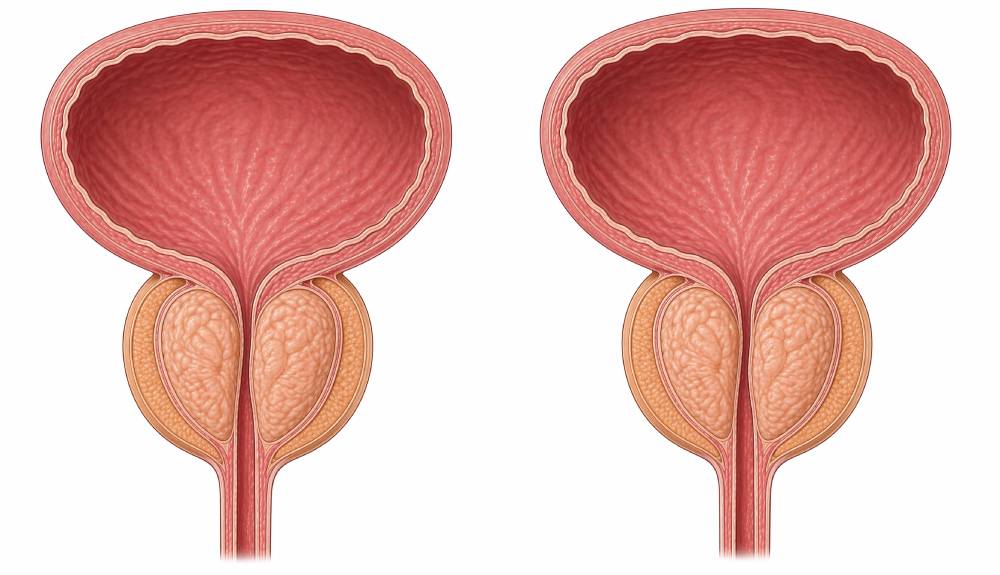
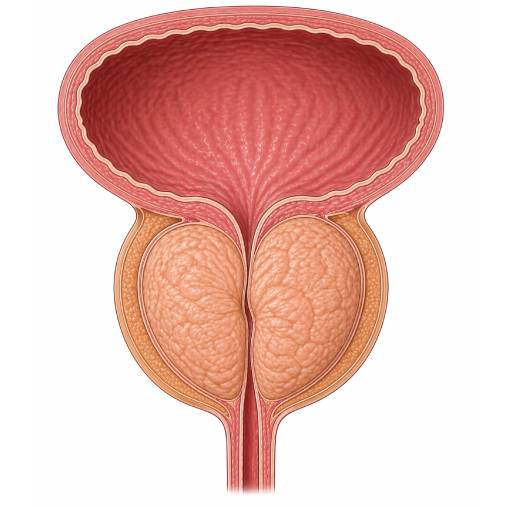
The prostate can be imagined as a little ring donut that sits at the bladder outlet- it is continuous with the bladder and the urethra and urine passes through the centre of the donut to leave the bladder.
Benign prostatic hyperplasia, or BPH, is a non-cancerous enlargement of the prostate gland that occurs with ageing. The central part of the prostate enlarges, in the form of a benign ‘mass’. It may narrow the urinary channel and make it harder for the bladder to empty. The donut hole, becomes obstructed. The size of the BPH prostate can vary, from 30cc to hundreds of cc in volume. The shape also varies, along with its effect on the lower urinary tract. The effect of BPH (rather than the size) generally dictates whether surgery is required, however the size and various patient factors determine the the type of surgery that is required.
Normal prostate vs enlarged obstructing BPH prostate:
What symptoms can an enlarged prostate cause?
Common symptoms include:
BUT not every urinary symptom in a man is caused by the prostate. A urologist should be able to assess for other causes of such symptoms.
What about Cancer?
Prostate cancer is more often than not a slow growing tumour. This tends to form near the back edge of the gland and often does not cause symptoms. It is detected either by PSA screening, or physical examination. Prostate cancer and BPH can occur in the same patient, and the treatment is individualised in these situations.
Why does BPH matter?
In some men, BPH is simply bothersome. In others, persistent obstruction can eventually lead to complications.
These may include:
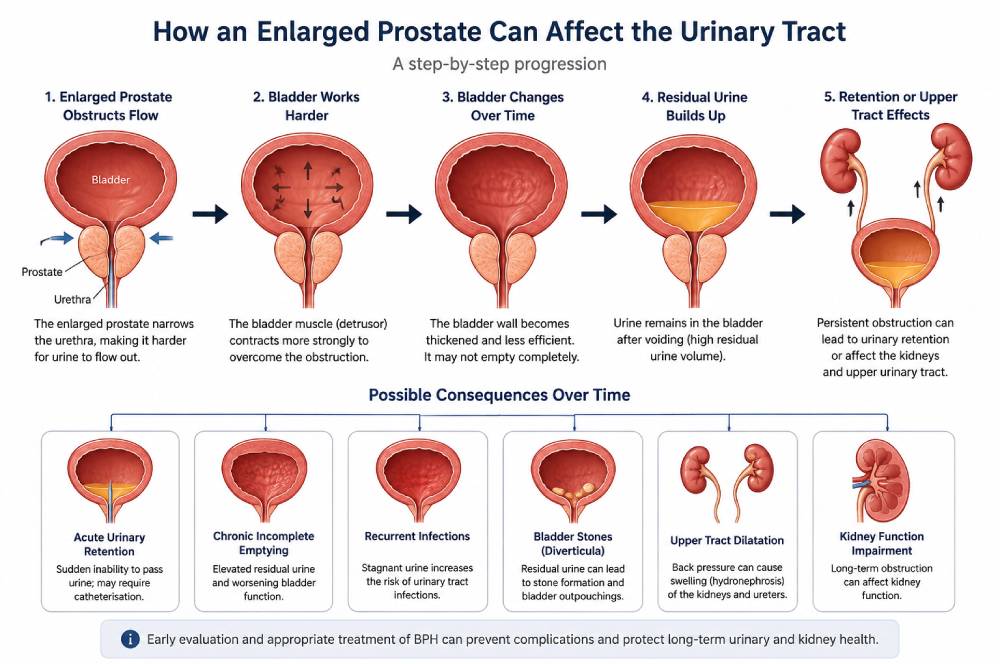
Enlarged prostate → bladder works harder → thickened bladder / residual urine → retention or upper tract effects
(Once the bladder begins to ‘work harder’,it becomes thickened and you will develop irritative urinary symptoms such as frequency and urgency of urination. Nowadays, we try to act to cure BPH surgically,before the bladder is permanently damaged in this way. )
How is BPH assessed?
A proper BPH assessment looks at more than prostate size.
It may include:
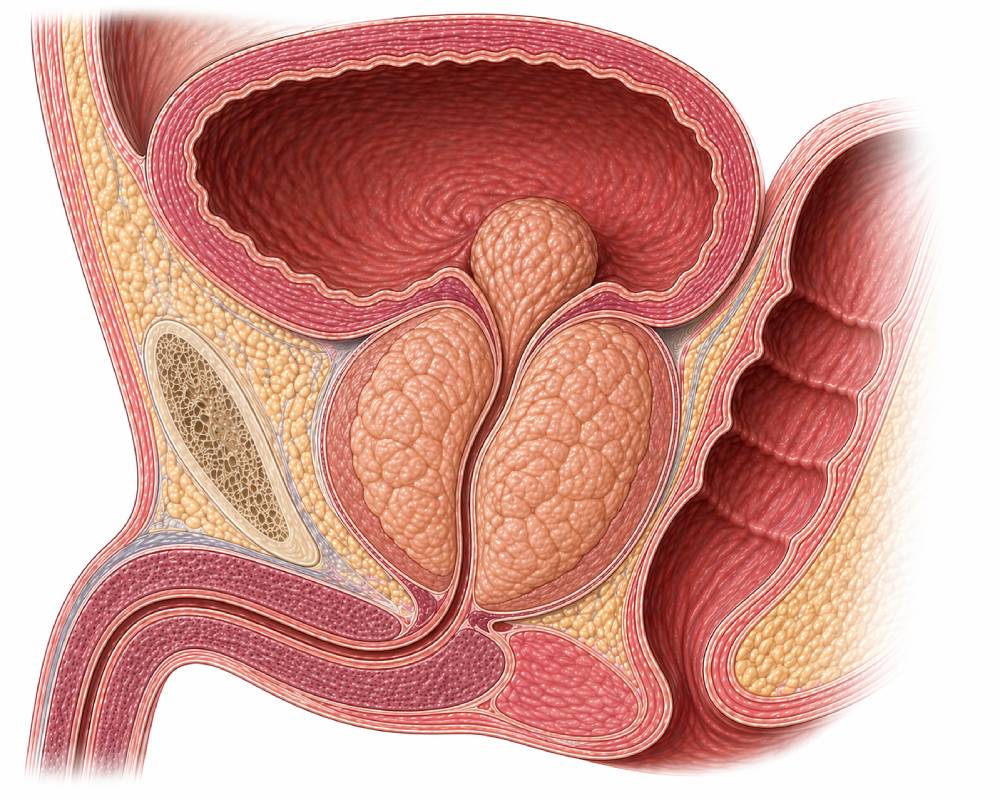
Prostate shape and anatomy, including median lobe and intravesical prostatic protrusion, matter alongside size. Hence I prefer to do their own ultrasound scan, to assess the shape/morphology of the BPH prostate.
Sometimes the gland may NOT be too large, however the median lobe of the prostate may protrude into the bladder and physical obstruct the drainage.
Ball-Valve Effect of a Large Median Lobe of the Prostate, where the rest of the gland is not too large. Unfortunately, medical therapy will not help these pateints, and I recommend early surgery for such cases:
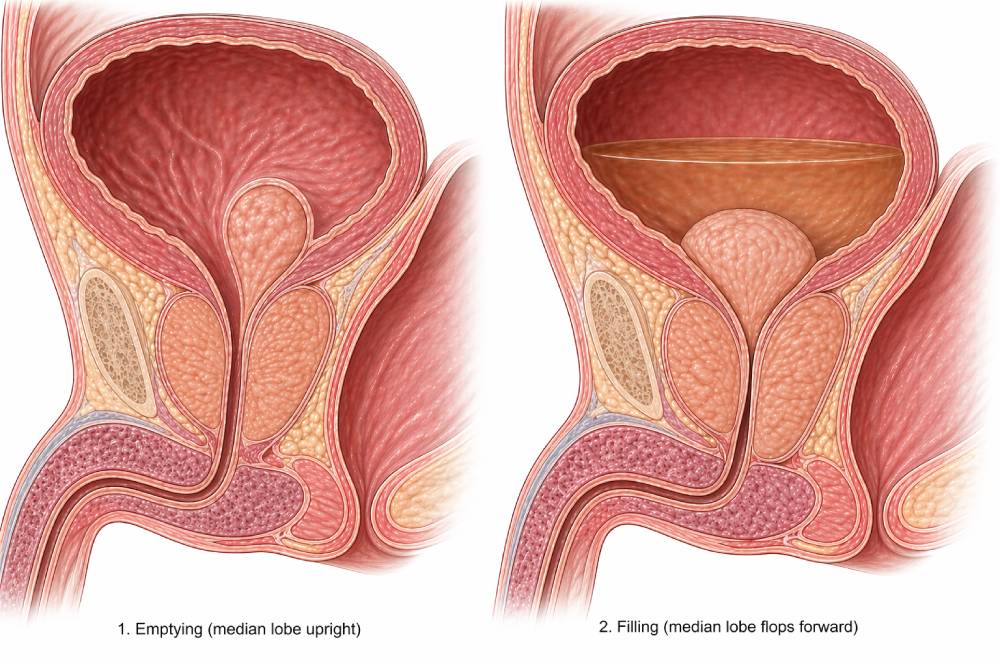

The obstruction, causes a strain on the bladder, which causes thickening of the bladder wall, and subsequent irritative lower urinary tract symptoms.
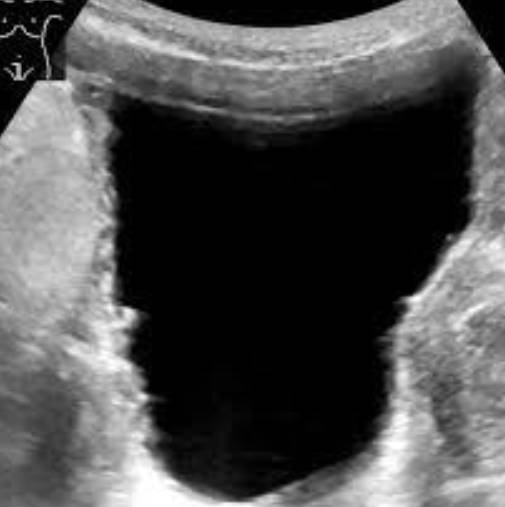
Large BPH prostate with a thickened bladder:
A large BPH gland AND a protruding Median lobe
One of the biggest changes in BPH management over recent years, has been the acceptance of the Patient-Centred Approach (vs the traditional linear model of management). And as an expert in this field, I wholeheartedly agree with the direction that BPH care has taken!

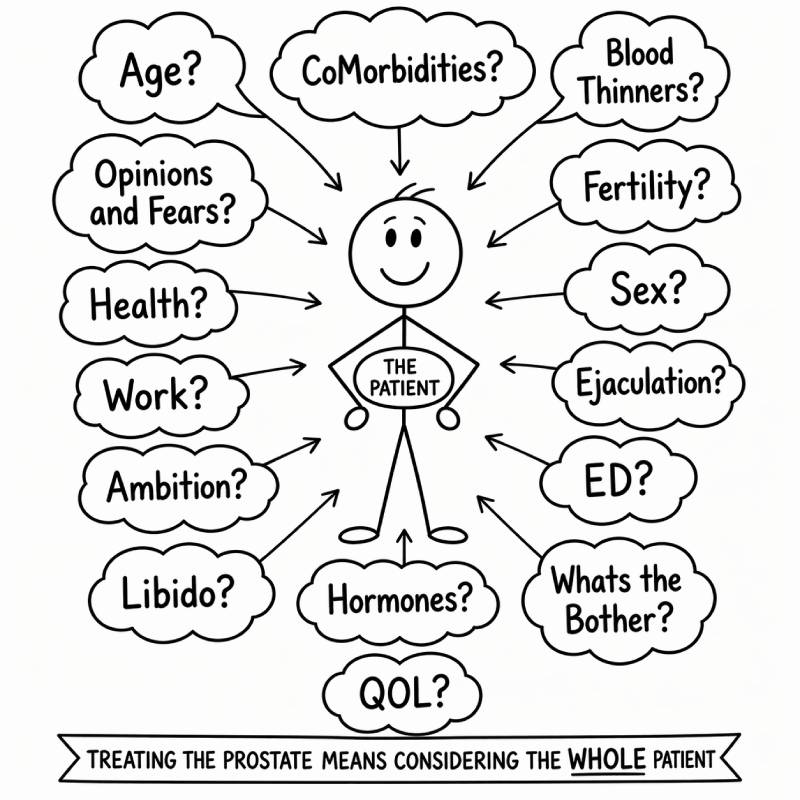
Treatment should be tailored to the patient.
Treatment depends on factors such as:
Treatment Options for BPH
Observation and Lifestyle measures
For men with mild symptoms and no complications, monitoring and simple behavioural measures may be appropriate. Mild BPH symptoms can sometimes be improved by simple measures such as reducing evening fluids, limiting caffeine and alcohol, avoiding large volumes of fluid at once, treating constipation and using techniques such as double voiding. Medications that may worsen urinary symptoms should also be reviewed with your doctor.
Lifestyle measures can improve symptoms but do not necessarily treat the underlying prostate obstruction. Men with significant obstruction, urinary retention or complications require further assessment.
Medication
Alpha blockers (Flomax,Uromax,Tamsulosin,Cardura,Silodyx); Beta-agonists(Betmiga, Urton) can improve symptoms in many men. Medication may be appropriate when symptoms remain manageable and complications are absent. Other medication may also reduce the size of the gland over time as well(5 alpha reductase inhibitors).
Minimally invasive surgical therapy (MIST)
REZUM
Water vapour therapy(Rezum) may suit selected men who want a minimally invasive option and where preservation of ejaculatory function is an important consideration. Such therapy preserves ejaculation function in 90% of cases.
Rezum is not a first line option in international guidelines for BPH, however, it is suited to cases where the prostate is below 60cc, or in cases where preservation of antegrade ejaculation is important to the patient.
Super Heated Water Vapour is injected into the prostate under a short anaesthetic. This causes changes within the BPH adenoma that result in the abnormal cells causing the enlargement to die off- they are then taken up by the body, causing a reduction in prostate volume. This process takes 3- 6 months.
Other minimally invasive approaches may also be suitable depending on prostate anatomy and availability. Internationally, Urolift, and Aquablation offer to preserve ejaculatory function, however these therapies are not available in South Africa, and there are no immediate plans for their introduction locally.
TURP(Transurethral resection of the prostate)
TURP uses electrocautery to cut away small chips of the BPH mass, to create a funnel through the mass for urine to drain out the bladder. In cases where the prostate is not too large, the bulk of the enlarged prostate can be removed in this manner.
This has traditionally been regarded as the gold-standard surgical treatment for BPH glands less than 60-80cc in size, because of its long track record, extensive evidence base, and widespread availability. BPH is a common problem, and all urologists are trained to perform a simple TURP.
However, prostate surgery has evolved. HoLEP (Holmium Laser Enucleation of the Prostate) offers outcomes comparable to or better than TURP in several measures, can be used across a much broader range of prostate sizes, and has a favourable peri-operative profile, including advantages in bleeding, catheterisation and hospital stay.
Despite these advantages, HoLEP has not completely replaced TURP, largely because it is a technically demanding procedure with a significant learning curve and requires specialised equipment, training and surgical expertise that are not universally available. Not every urologist can or should perform HoLEP surgery. For these reasons, TURP remains an important traditional benchmark, while HoLEP has increasingly emerged as a modern anatomical alternative where appropriate expertise is available.
The European Association of Urology strongly recommends HoLEP as an alternative to TURP or open prostatectomy and notes the importance of surgeon experience and mentorship in achieving optimal outcomes. If you are being offered a TURP for your slightly enlarged prostate, in a setting where your urologist has not been trained in HoLEP, and where no
HoLEP facility is available, then it certainly will do the job.
Should your prostate be significantly large, 60-80grams or larger, or should you have several medical risk factors, or are on anticoagulant therapy, you should seek out a HoLEP trained urologist in your area.
HoLEP (Holmium Laser Enucleation of the Prostate)
HoLEP employs a holmium laser fibre to remove the entire obstructing inner prostate mass, by following the natural plane between the adenoma(the BPH mass) and the outer surgical capsule. The mass is dropped into the bladder and then broken down(morcellated) and suctioned out. This allows for removal of all the BPH tissue, which reduces the rate of retreatment. Blood loss is minimal and the surgical time for an 80cc prostate ranges from 20 minutes to 60 minutes.
The bladder is washed out with a catheter for 12 – 24 hours before the bladder catheter is removed. My patients are typically discharged the morning after surgery.
Some patients may leak urine for a short period after the procedure. The rate of long term urinary incontinence is not more than that experienced with other BPH procedures.
Further to the above, some urinary urgency and blood in the urine may be expected for up to 4 weeks after the procedure.
This is a specialised procedure that must be performed by a urologist specifically trained in HoLEP. It is largely considered the modern gold standard across many parts of the world, and its superior efficacy and safety profile are supported by European and American Urology Guidelines.
One important advantage is that HoLEP can be used across a broad range of prostate sizes, including very large glands. It is the recommended standard of care across the world, for patients with prostates larger than 80cc in volume, or those with any size of gland,on anticoagulant therapy. This has replaced the need for open prostate surgery for BPH. If you are being offered open surgery for BPH – please seek a second opinion from a HoLEP trained urologist.
Studies reveal durable outcomes, low retreatment rates(5%), use in selected anticoagulated patients and relatively short catheterisation/hospital stay. HoLEP is also the more cost effective therapy in the hands of an experienced surgeon.
HoLEP in South Africa has grown over recent years, and has evolved enormously since a colleague and myself introduced this therapy to South Africa several years ago. A competent HoLEP Urologist can now be found in most major South African cities.
Ejaculatory Sparing HoLEP
TURP and HoLEP surgery does result in dry ejaculation, which is a permanent(but harmless) side effect. If this is a concern, it should be discussed with your surgeon preoperatively. I am happy to offer an Ejaculatory-Sparing HoLEP, or alternative options such as Rezum therapy can be discussed.
https://www.wismed.co.za/new-blog/bph-and-my-journey-with-holep-by-dr-santosh-bugwandin
Scroll down for more information about HoLEP.
Alternative Treatments:
Other treatments are available, which lack the equivalent efficacy as HoLEP and TURP, however they may be considered in selected cases:
Prostatic Artery Embolisation (PAE)
Prostatic Artery Embolisation (PAE) is a minimally invasive treatment performed by an interventional radiologist. Through a small arterial puncture, the blood vessels supplying the prostate are identified and tiny particles are used to occlude the vessels reduce its blood supply, causing the prostate to gradually shrink and potentially improve urinary symptoms. Improvement in urinary flow and obstruction is typically less pronounced than with surgery, and retreatment rates are higher(20% require surgical intervention after PAE).
The European Association of Urology therefore recommends PAE as an option for appropriately selected men who accept potentially less optimal outcomes than HoLEP/TURP, with patient selection and follow-up undertaken collaboratively by a urologist and appropriately trained interventional radiologist.
I normally recommend Prostate artery embolisation to those patients who want to preseve ejaculation, but who have prosate glands larger than 80cc in volume. In patients with smaller glands wanting to preseve ejaculation, I offer Rezum therapy or Ejaculatory sparing HoLEP.
Prostatic Stents / Temporary Prostatic Devices
Prostatic stents are designed to mechanically open the obstructed prostatic urethra without removing prostate tissue. A device is placed through the urethra and expands or reshapes the prostatic channel, allowing urine to pass more easily. They are not suitable for all prostate sizes or anatomies, do not remove the underlying enlarged prostate tissue, and the evidence and long-term durability are less established than for conventional surgical treatments such as TURP or HoLEP. There is a high rate of migration, and the device is often uncomfortable. They do not form part of standard guidleines of BPH management.
I consider stents as an option in the pateint who has had previous radiotherapy and who has now experienced severe obstructive urinary symptoms relating to an occlusive scarred prostate. I do not otherwise use them for BPH.
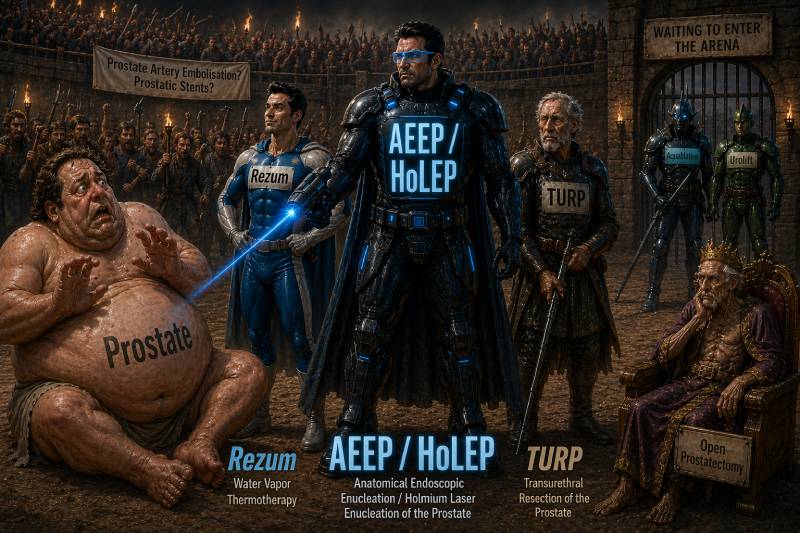
Cost of various therapies, and where therapies fit:

When should surgery be considered?
Surgery may be discussed when:
A personalised approach to BPH
Treating BPH is not simply about treating a large prostate.
The aim is to understand the urinary symptoms, prostate anatomy, bladder function, medical health and the patient’s priorities, and then choose the most appropriate treatment.
If you are experiencing troublesome urinary symptoms, urinary retention or have been told that you have an enlarged prostate, specialist assessment can help determine the most appropriate treatment.
I have extensive experience in managing BPH, and perform several HoLEP and Rezum procedures each month.
Our practice regularly sees challenging, complex BPH cases, including high risk patients who were considered unfit for traditional prostate surgery; patients who have lived with catheters for years; those with massive prostates- but most commonly – patients with fairly straightforward BPH see me for HoLEP/Rezum surgery becasue they want a less morbid intervention with a rapid return to daily activity.
If one of these fits your description, then contact us for an assessment.